How to Measure Pupillary Distance at Home: 4 Methods Compared
How to measure your PD at home with a ruler, mirror, credit card photo or webcam, how accurate each method is, and when to ask an optician instead.
If you have ever tried to buy glasses online, you have hit this wall: the checkout asks for your pupillary distance, your prescription does not list it, and the optician who measured you is not answering the phone.
Pupillary distance — PD, or interpupillary distance — is the distance in millimetres between the centres of your pupils. It tells the lab where to place the optical centre of each lens. Get it wrong and you are looking through the wrong part of the lens, which is exactly as uncomfortable as it sounds.
This guide covers four ways to measure it yourself, what each is actually accurate to, and when the error starts to matter.
Why does pupillary distance matter?
Every lens has an optical centre — the one point where light passes through without being bent sideways. The lab positions that centre based on your PD. When it sits where your pupil sits, you look straight through it and the lens does exactly what the prescription intended.
When it does not, the lens starts behaving like a prism. Your eyes compensate by rotating slightly inward or outward, and holding that compensation is what produces the classic symptoms of a bad fit: eye strain after an hour of reading, headaches at the temples, mild nausea, and the feeling that the floor is tilted when you walk downstairs in new glasses.
The amount of unwanted prism follows Prentice's rule:
Prismatic effect (prism dioptres) = decentration in centimetres × lens power in dioptres
The practical consequence is that error tolerance is not fixed — it scales inversely with your prescription strength.
54–74 mm
Normal adult PD range
~63 mm
Average adult PD
2 mm
Tolerable error, low power
1 mm
Tolerable error, progressives
Here is what that means in practice for a 3 mm measurement error:
| Lens power | Prism induced by 3 mm error | Typical experience |
|---|---|---|
| −1.00 D | 0.3 Δ | Unnoticeable for most wearers |
| −3.00 D | 0.9 Δ | Mild strain during long reading sessions |
| −6.00 D | 1.8 Δ | Persistent headaches, visible distortion |
| Progressive, any power | — | Corridor misaligned; blurred mid-distance zone |
If you wear a light prescription for occasional screen use, a rough measurement will serve you fine. If you are above 4.00 dioptres or buying progressives, precision stops being optional.
How do I measure PD with a ruler and a friend?
The traditional approach, and the one most online guides lead with.
Position yourselves
Sit down. Have your friend stand roughly 40 cm in front of you, at eye level — not above or below, which is where most of the error creeps in.
Fix your gaze
Look at something far away, past their shoulder. A distant object relaxes your eyes into their natural far-distance alignment.
Align the ruler
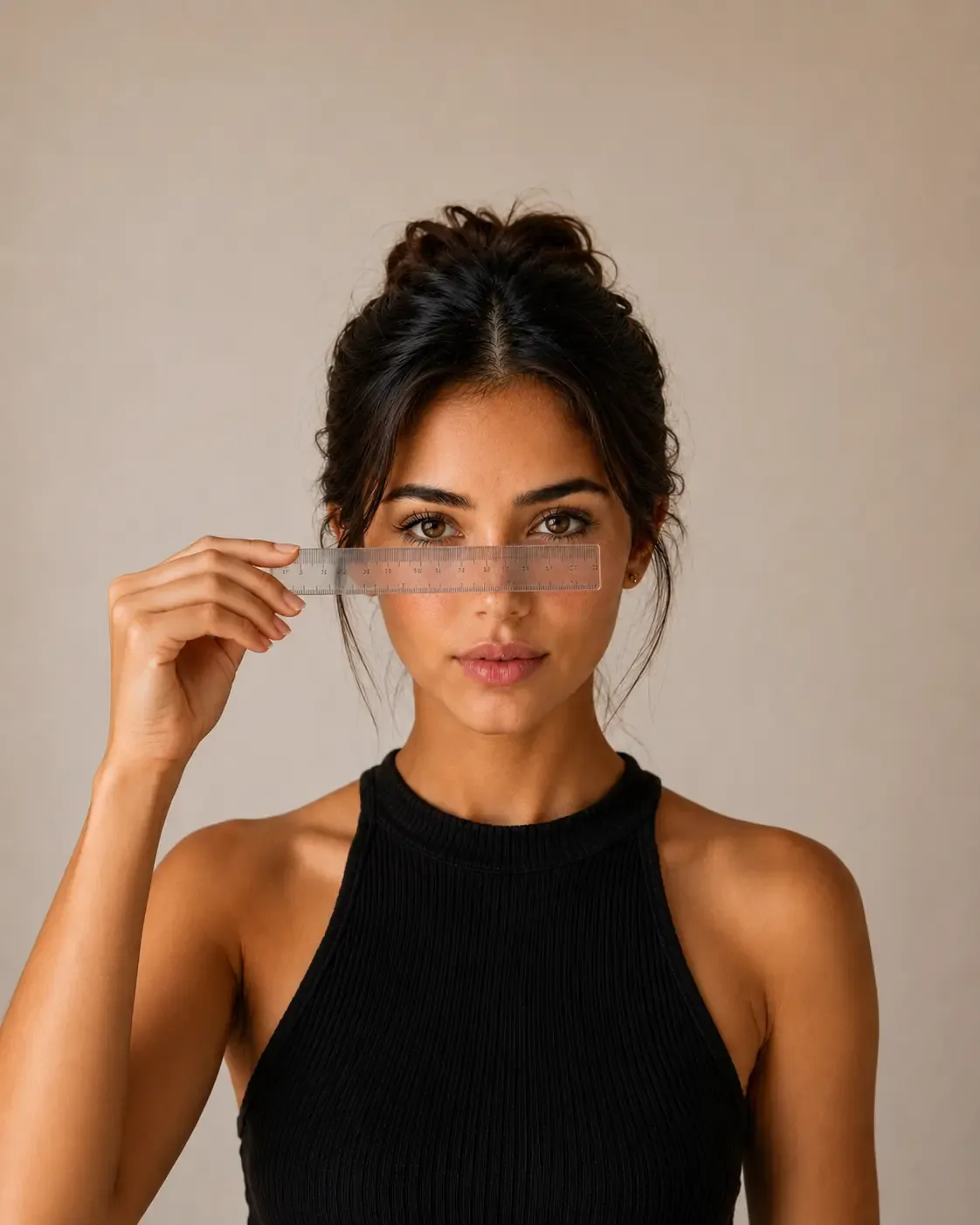
Your friend rests a millimetre ruler against your brow and aligns the zero mark with the centre of your right pupil.
Read across
Without moving the ruler, they read the value at the centre of your left pupil. That number is your binocular PD.
Repeat
Do it three times and average. If the readings vary by more than 2 mm, the ruler is drifting — restart with the ruler resting firmly against the brow.
Realistic accuracy: ±2–4 mm. The weakness is not the ruler, it is the two pairs of eyes involved. Your friend is judging the centre of a moving pupil from an angle, and any horizontal offset in their viewing position translates directly into parallax error.
How do I measure PD alone with a mirror?
Counterintuitively, doing it alone is often more accurate than doing it with help, because it eliminates the second observer's viewing angle entirely.
Stand close to a mirror
About 20 cm away, facing it squarely. Your reflection is now effectively at 40 cm — the same working distance as the ruler method.
Close your right eye
Hold the ruler against your brow and align the zero mark with the centre of your left pupil, using only your open left eye.
Switch eyes without moving
Open your right eye and close your left. Do not move your head or the ruler.
Read your right pupil
Read the millimetre mark that now falls at the centre of your right pupil.
Alternating eyes is the trick: each measurement is taken along the line of sight of the eye being measured, so there is no parallax to correct for.
Realistic accuracy: ±1–2 mm. Add roughly 3 mm to the result if you want your true far-distance PD, since the mirror puts your effective focus at 40 cm rather than infinity — or simply measure your near PD deliberately if the glasses are for reading.
How do I measure PD with a credit card photo?
Explore pupillary distance with a credit card for capture guidance and the card-based measurement solution for eyewear stores.
This is the approach most smartphone PD apps use, and it is worth understanding because it is probably what you will meet first if you go looking.
You photograph your face holding an object of known width against your forehead — usually a credit card, since every ID-1 format card is manufactured to 85.6 mm wide. The app finds your pupils in the image, measures the distance between them in pixels, and scales that against the card to convert pixels into millimetres.
Realistic accuracy: ±2–3 mm, and it degrades in ways that are hard to spot. The card has to sit in exactly the same plane as your pupils to scale correctly, but held against your forehead it is typically 20–30 mm in front of them — enough to inflate the result by a couple of percent on its own. Camera lens distortion adds error toward the edges of the frame, and any head tilt shortens the apparent pupil distance without shortening the card.
How does webcam PD measurement work?
The newest approach removes the reference object entirely. Instead of scaling against something you hold up, it scales against something you were already born with: your iris.

Why the iris works as a ruler
The horizontal diameter of the human iris is one of the most stable measurements in human anatomy. Across adults it stays at roughly 11.7 mm, give or take 0.5 mm, largely independent of age, gender, or ethnicity — a finding Google's research team relied on when building the iris tracking that this class of tool is based on.
That constancy is what makes the maths work. If a model can find the boundary of your iris precisely, it has a ruler of known length sitting in exactly the same plane as your pupils — which is precisely the condition the credit-card method fails to meet.
How the measurement is put together
The pipeline runs in three stages, all inside your browser:
Find the face
A facial landmark model fits a dense mesh to your face — the same face-mesh technology behind face shape detection. It locates the eye region and, just as importantly, works out how your head is turned.
Track the irises
A second model looks only at the cropped eye regions and traces the iris boundary and eye contour in each one, far more precisely than a whole-face model could.
Convert to millimetres
Knowing the iris is 11.7 mm wide and how many pixels it occupies gives the scale factor for that frame. Head pose corrects for tilt and rotation, and the result is averaged across many frames rather than trusting a single snapshot.
Three things make this more accurate than the photo method: there is no reference object, so no focal-plane mismatch; head pose is solved explicitly instead of silently biasing the result; and hundreds of frames are averaged, so blinks, micro-movements, and detection noise cancel out instead of landing in one unlucky measurement.
Realistic accuracy: ±0.5 mm against optician measurement — inside the tolerance for progressive lenses.
Which PD method is most accurate?
| Method | Accuracy | Needs help | Needs a reference object | Good enough for progressives |
|---|---|---|---|---|
| Ruler + friend | ±2–4 mm | Yes | Ruler | No |
| Mirror + ruler | ±1–2 mm | No | Ruler | Marginal |
| Smartphone app (photo + card) | ±2–3 mm | No | Credit card | No |
| Webcam iris detection | ±0.5 mm | No | None | Yes |
Binocular vs monocular PD
Everything above measures binocular PD — the total pupil-to-pupil distance. For most single-vision lenses that is all the lab needs.
Monocular PD measures each eye separately, from the pupil to the centre of the nose bridge. It matters because faces are not symmetric: a 64 mm binocular PD might genuinely be 33 mm on the right and 31 mm on the left. Split evenly at 32/32, both optical centres land 1 mm off.
You need monocular values when:
- Your prescription exceeds about 4.00 dioptres in either eye
- You are ordering progressive or bifocal lenses
- You have noticeable facial asymmetry, or previous glasses that never felt right
Manual methods cannot produce reliable monocular values — finding your own nose-bridge centre by eye is guesswork. Face-mesh tracking gives them for free, because the bridge point is one of the landmarks it already solves for.
For retailers: measuring PD inside your own checkout
If you sell prescription eyewear online, the PD field is one of the highest-friction moments in your funnel. The shopper either abandons, guesses, or enters a value they half-remember — and the third option is the expensive one, because it produces a remake at your cost.
Embedding measurement directly in the flow removes the decision. Instead of asking for a number the shopper does not have, you give them a button that produces it in about three seconds, then write the result straight into the order.
Practically, it is a single embed on the page where the PD field lives. There is no SDK to install and no build step: you drop in the widget, point it at your account key, and the measurement result comes back to your page ready to attach to the order. Everything runs on the shopper's device, so no image is uploaded and nothing needs to be stored on your side. The widget documentation has the exact setup.
Which method should you use
If you wear a mild single-vision prescription and just need a number for a cheap second pair, the mirror method takes two minutes and is accurate enough.
If you are above 4.00 dioptres, buying progressives, or spending real money on lenses, measure with something that removes human judgement from the loop — an iris-based webcam tool, or an optician. The cost of a remake is always higher than the cost of measuring properly the first time.
And whichever method you use, measure three times. Any approach that gives you the same number three times in a row is telling you something the single measurement cannot.
Frequently asked questions
What is a normal pupillary distance?
Most adults fall between 54 mm and 74 mm, with an average near 63 mm for men and 60 mm for women. Children typically range from 43 mm to 58 mm. Anything inside those bands is normal — PD is an anatomical measurement, not a health indicator, and there is no better or worse value.
How accurate does my pupillary distance need to be?
For single-vision lenses under about 2.00 diopters, an error of 2 mm is usually tolerable. Above 4.00 diopters, or for any progressive lens, 1 mm of error is already enough to produce eye strain or headaches, because the induced prismatic effect scales with both lens power and decentration.
Can I measure my pupillary distance alone?
Yes. The mirror method and webcam-based tools are both designed for solo measurement. The classic ruler method is the one that genuinely needs a second person, because holding a ruler against your own brow while focusing on a distant object introduces parallax error you cannot see.
What is the difference between binocular and monocular PD?
Binocular PD is the total distance between both pupils. Monocular PD measures each pupil to the centre of the nose bridge separately. Most faces are slightly asymmetric, so a 64 mm binocular PD might break down as 33 mm and 31 mm. Progressive and high-power lenses need the monocular pair.
Is my pupillary distance on my prescription?
Often not. In many countries opticians are not required to include PD on a written prescription, since it is a fitting measurement rather than a refraction result. You can request it — they are generally obliged to provide it on request — or measure it yourself using one of the methods below.