Why Diamonds Look Dull in Photos (and What Actually Fixes It)
A diamond makes three kinds of sparkle and a still photo shows only one. The optics behind dull diamond photos, and how real-time 3D brings fire back.
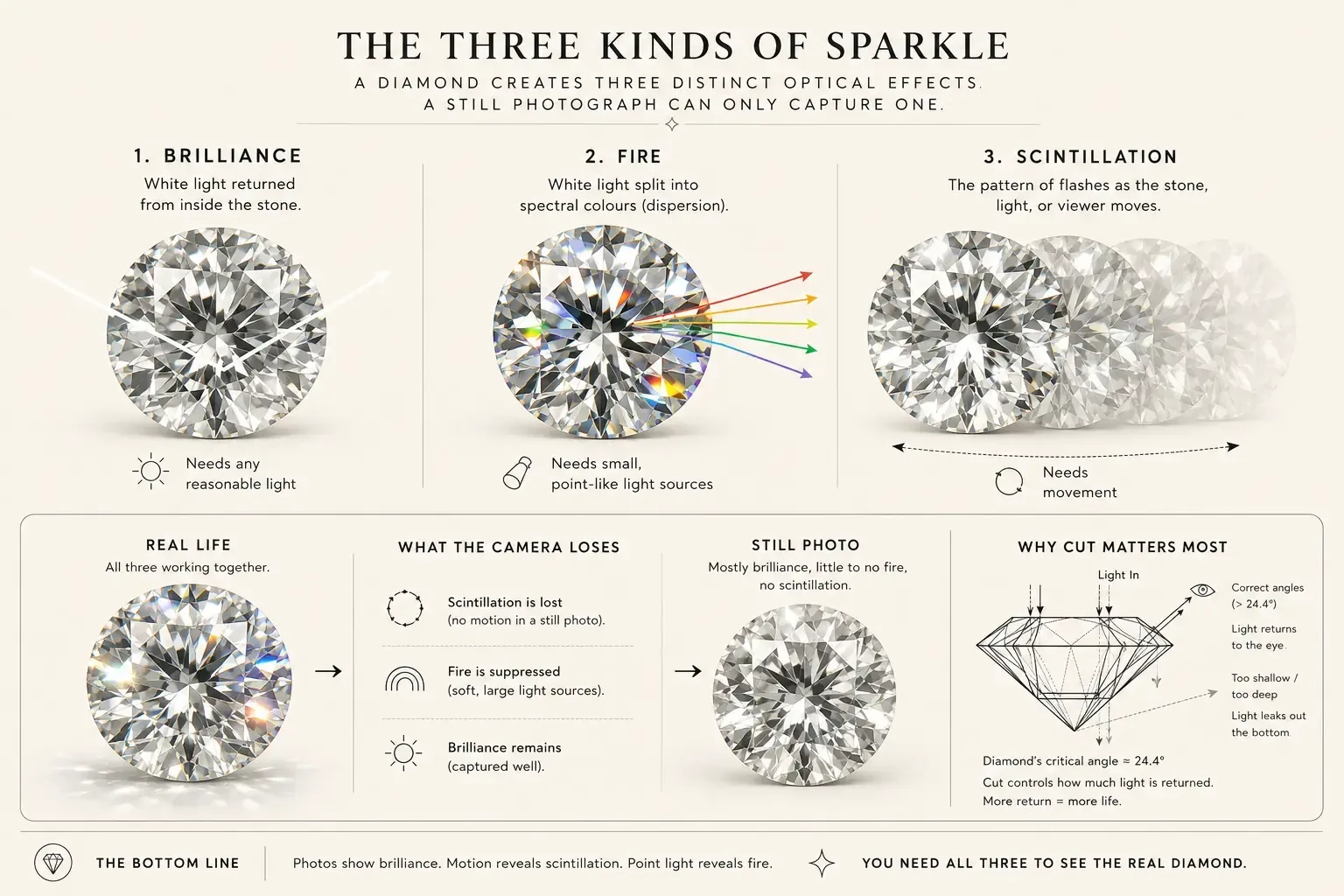
Every jeweller has had this conversation. A customer looks at a diamond online, then sees it in person, and says some version of it looks completely different. Usually better. Sometimes worse, which is a harder conversation.
The reason is not photography skill. It is that a diamond produces three physically distinct optical effects, and a still image is structurally incapable of showing two of them.
What are the three kinds of diamond sparkle?
Jewellers separate what people loosely call "sparkle" into three components. They come from different physics and behave differently.
| Effect | What it is | What it needs to appear |
|---|---|---|
| Brilliance | White light reflected back out of the stone | Any reasonable light source |
| Fire | White light split into spectral colours by dispersion | Small, point-like light sources |
| Scintillation | The flashing pattern of light and dark as things move | Movement of stone, light, or viewer |
Brilliance is the easy one. It survives photography, which is why product photos of diamonds look bright and lifeless at the same time — bright is brilliance, and lifeless is the absence of the other two.
Why does a photograph lose two of them?
Scintillation cannot survive a still image by definition. It is a time-based phenomenon: the pattern of flashes as the relationship between stone, light, and eye changes. Freeze that into a single frame and you have one arbitrary instant of a pattern whose entire character is its change. No amount of resolution recovers it.
Fire is suppressed by good studio practice. Dispersion separates white light into colours, but the effect only reads as distinct coloured flashes when the light source is small relative to the stone — a spotlight, a candle, direct sun. Product photography uses large softboxes precisely because they produce even, flattering, shadow-free illumination. That is the correct choice for showing a setting cleanly, and it is close to the worst case for fire. Big soft sources wash the spectral colours back together into white.
So the standard jewellery shot is optimised for exactly the one effect that photographs well, using lighting that kills the other two.
2.42
Refractive index of diamond
24.4°
Critical angle for internal reflection
57–58
Facets on a round brilliant cut
3
Distinct optical effects to convey
The optics underneath: refraction and dispersion
Diamond's behaviour comes from an unusually high refractive index — about 2.42, far above most gemstones. Two consequences follow.
First, light entering the stone bends sharply and slows dramatically, which is what makes the internal light paths so complex.
Second, and more importantly, diamond has a critical angle of roughly 24.4 degrees. Light striking an internal facet at an angle beyond that is totally internally reflected — it cannot escape, and bounces back into the stone. This is the mechanism that makes a diamond return light to the viewer instead of letting it pass through.
It is also why cut dominates. Facets have to be angled so that light entering the top reflects internally and exits back through the top toward the eye. Cut too shallow or too deep and light strikes facets at angles below the critical threshold, passes straight through the bottom, and is lost. The stone looks dark in the centre or glassy and flat — regardless of how good its clarity and colour grades are.
What conveys diamond sparkle online?
The industry's first answer was 360-degree video, and it was a real improvement — motion restores scintillation, which is the single largest missing piece. It has three remaining limits: the viewer cannot choose the angle, the lighting is still the seller's, and producing one for every stone is a physical photography operation that does not scale.
Real-time 3D rendering addresses the same problem differently. The stone is a geometric model, and light is simulated against it as the viewer moves:
- The viewer controls the motion, so scintillation appears in response to their own input rather than a fixed camera path — much closer to tilting a ring under a light
- The environment is a real lighting model, so small bright sources can be present in the scene and fire actually appears rather than being averaged away
- Refraction and dispersion are computed, not photographed, so the coloured flashes come from the same physics that produces them in reality
- It scales to a catalogue, because it renders from the stone's geometry rather than requiring each physical item to be shot
The honest caveat: a render shows an accurate representation of a stone with those specifications, not a photograph of the individual stone in your safe. For most online jewellery — settings, bands, standard cuts — that is exactly what a shopper needs. For a high-value certified solitaire, pairing it with real imagery of the actual stone is the stronger combination.
That is why a jewelry 3D viewer shows a diamond better than a photo: refraction and dispersion are computed in real time, so fire and scintillation change as the shopper turns the stone. To show the ring on the hand at real size, add AR ring try-on.
Tips for jewelry retailers
Let people move it. The single largest gain over a static image is putting rotation under the shopper's control. Motion is not decoration here; it is the missing optical effect.
Do not over-light the scene. The instinct is to make everything bright. Some contrast and some small, sharp light sources are what produce fire — a scene lit entirely with soft ambience will look as flat as the photograph you were trying to improve on.
Pair it with scale context. A viewer conveys light performance, not size. Rings especially need proportion against a real hand, which is a different problem — why a ring never looks the same on your hand covers that side.
Set expectations about lighting. A stone that looks spectacular under sharp light will be quieter under an overcast sky. Saying so builds more trust than it costs, and it prevents the return that starts with "it doesn't sparkle like it did online."
The 3D jewelry viewer page shows what the shopper-facing result looks like, and the documentation covers embedding it and loading your own models.
Frequently asked questions
What are brilliance, fire, and scintillation?
Brilliance is the white light returned from inside the stone. Fire is the coloured flashes produced when the diamond splits white light into spectral colours. Scintillation is the pattern of flashes that appears as the stone, the light, or the viewer moves. Together they make up what jewellers call light performance.
Why does a diamond look better in person than online?
Because two of the three kinds of sparkle depend on movement and on having many light sources. A still photograph freezes motion, which removes scintillation entirely, and studio lighting is usually a small number of large soft sources, which suppresses fire. What is left is mostly brilliance.
Does a video show a diamond better than a photo?
Yes, considerably — motion restores scintillation, which is why 360-degree videos became standard for online diamond retail. The remaining limits are that the viewer cannot control the angle, the lighting is still the seller's choice, and the video shows one specific physical stone under one specific setup.
What makes a diamond sparkle more?
Cut, more than any other factor. Diamond has a critical angle of about 24.4 degrees, so facets have to be angled precisely for light to reflect internally and exit through the top. A well-cut stone returns light; a poorly cut one leaks it through the bottom and looks lifeless regardless of clarity or colour grade.